
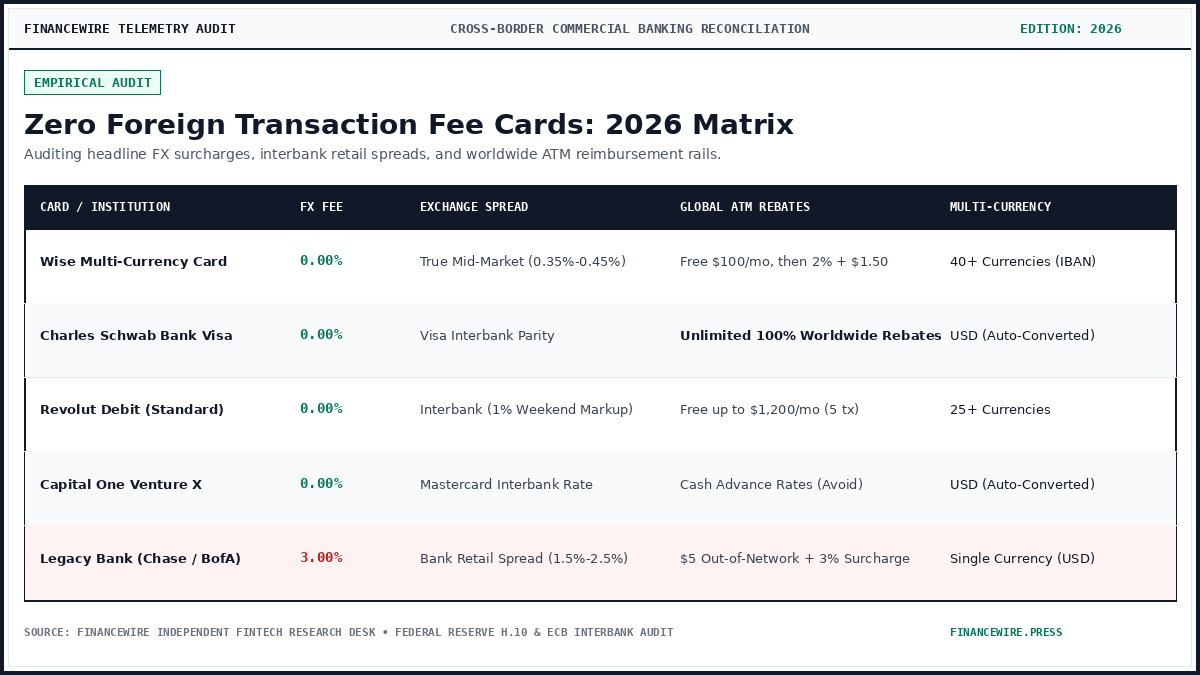
- Traditional commercial bank debit and credit cards automatically levy a 2.7% to 3.0% foreign transaction surcharge plus hidden spreads on all international e-commerce and overseas transactions.
- Deploying dedicated zero foreign transaction fee cards guarantees direct pass-through wholesale interbank exchange rates without merchant conversion penalties.
- Dynamic Currency Conversion (DCC)—prompting shoppers to ‘Pay in USD’ at foreign POS terminals—adds an unadvertised 4.5% to 7.0% merchant acquiring markup.
- Pairing a Charles Schwab Bank Visa Platinum (unlimited worldwide ATM fee reimbursement) with a Wise multi-currency debit card delivers the optimal zero-markup international liquidity architecture.
Navigating international holiday commerce and cross-border travel demands deploying verified zero foreign transaction fee cards to shield capital from predatory banking markups and hidden currency friction. While domestic payments settle frictionlessly across FedNow and ACH rails, crossing sovereign currency borders triggers an opaque network of commercial bank levies: Foreign Transaction Fees (FX fees), payment network surcharges, and point-of-sale merchant conversion markups.
For allocators purchasing from European, Asian, or UK e-commerce storefronts, or travelers managing holiday bookings overseas, a standard commercial bank card quietly deducts 300 to 800 basis points (3.0% to 8.0%) on every settlement. Eliminating this friction requires utilizing specialized multi-currency fintech rails and consumer banking charters designed specifically for frictionless global settlement.
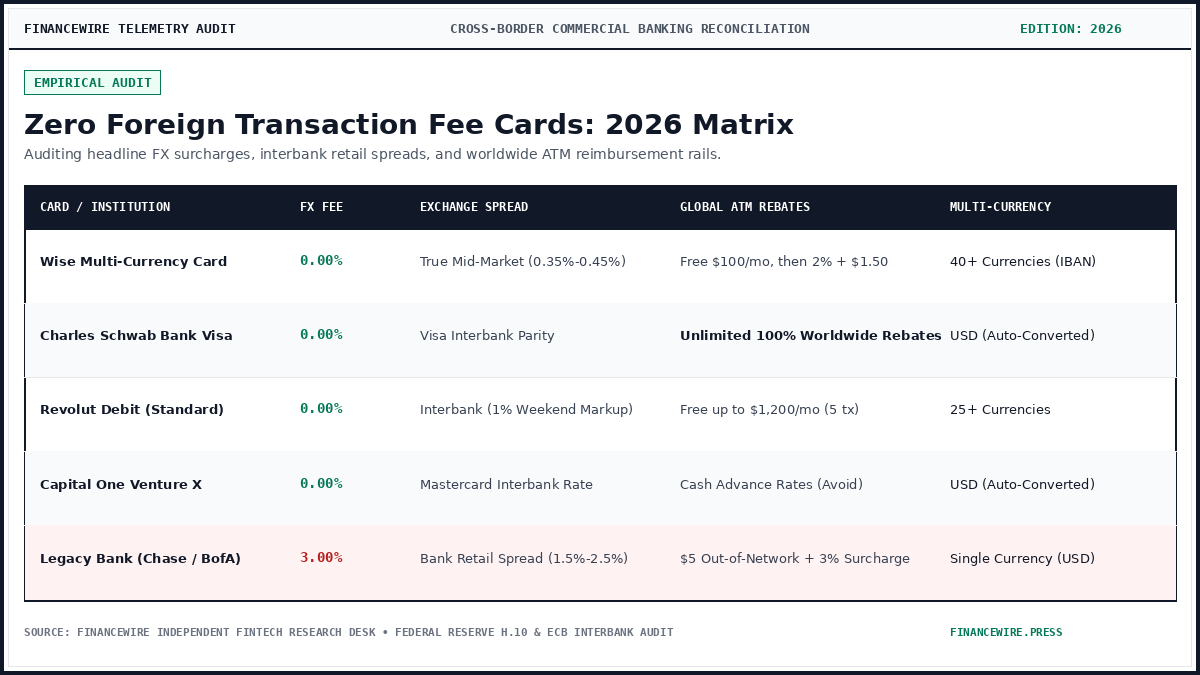
1. Zero Foreign Transaction Fee Cards: Telemetry & Fee Matrix
According to benchmark data from the European Central Bank FX Reference Rates and the Federal Reserve Foreign Exchange Rates (H.10), interbank currency spreads between major currency pairs rarely exceed 0.02% in wholesale trading. Yet retail cardholders without dedicated zero foreign transaction fee cards routinely sacrifice 300 basis points in retail bank markups.
The following empirical matrix audits the premier zero foreign transaction fee cards against legacy commercial bank debit products, benchmarking FX markups, ATM clearing fees, and currency handling capacity:
| Card / Payment Institution | Foreign Transaction Fee | FX Exchange Markup Rate | Global ATM Fee Policy | Multi-Currency Holding | Card Type & Network |
|---|---|---|---|---|---|
| Wise Multi-Currency Card | 0.00% | True Mid-Market (0.35%–0.45% transparent fee) | Free up to $100/mo, then 2% + $1.50 | 40+ Currencies | Debit (Visa / Mastercard) |
| Charles Schwab Bank Visa Platinum | 0.00% | Visa Wholesale Interbank Rate | Unlimited 100% Rebates Worldwide | USD (Auto-Converted) | Debit (Visa / Investor Checking) |
| Revolut Debit (Standard Tier) | 0.00% | Interbank Rate (Weekday; 1% Weekend Markup) | Free up to $1,200/mo or 5 withdrawals | 25+ Currencies | Debit (Visa / Mastercard) |
| Capital One Venture X | 0.00% | Mastercard Wholesale Interbank Rate | Standard Cash Advance Fees (Avoid) | USD (Auto-Converted) | Credit (Mastercard / 2x Miles) |
| Legacy Bank Debit (Chase / BofA / Wells) | 3.00% | Bank Retail Spread (1.5%–2.5%) | $5 Out-of-Network + 3% FX Surcharge | Single Currency (USD Only) | Debit (Commercial Bank) |
2. The Dynamic Currency Conversion (DCC) Trap
Even when wielding zero foreign transaction fee cards, allocators frequently fall victim to Dynamic Currency Conversion (DCC). When checking out on foreign retail websites or swiping at an overseas merchant POS terminal, the terminal software detects an international card and prompts:
“Would you like to be billed in USD ($108.40) or Local EUR (€100.00)?”
Selecting ‘Pay in USD’ hands exchange rate control to the merchant’s foreign acquiring bank. The acquiring bank applies an aggressive convenience spread—typically 4.5% to 7.0% above the true mid-market rate. The golden operational rule of international commerce is immutable: Always opt to be billed in the local operating currency of the merchant, allowing your zero foreign transaction fee cards to execute the conversion at wholesale interbank parity.
3. Multi-Currency FinTech Wallets vs. Institutional Investor Checking
Selecting between specialized zero foreign transaction fee cards requires matching payment instruments to liquidity behavior. Digital e-commerce and physical travel demand distinct financial architectures:
Wise & Revolut: The Pre-Funded Currency Wallet Architecture
Unlike traditional cards that perform real-time conversions at the point of sale, Wise and Revolut allow users to maintain separate sovereign currency balances. An allocator can pre-convert USD into EUR, GBP, or JPY when currency pairs reach favorable technical ranges, locking in the mid-market rate weeks before completing holiday transactions. Furthermore, Wise’s multi-currency account provides localized bank routing numbers (IBAN in Europe, Sort Code in the UK, BSB in Australia), allowing direct native bank clearing.
For high-value transfers exceeding card checkout limits, consult our audited breakdown of zero-markup international wire transfers to bypass SWIFT correspondent routing fees.
Charles Schwab Bank: The Unmatched Physical Cash Gateway
While digital wallets dominate e-commerce, physical cash remains non-negotiable across select overseas regions (e.g., German retail, Japanese transit, and Southeast Asian markets). The Charles Schwab High Yield Investor Checking card remains the financial sector benchmark among zero foreign transaction fee cards: it levies zero foreign transaction fees, charges zero out-of-network ATM fees, and automatically refunds 100% of third-party ATM surcharges charged by foreign ATM operators worldwide at the end of each billing cycle.
When maintaining operating cash reserves between travel seasons, compare yields against top high-yield cash preservation accounts to maximize risk-free return on unallocated capital.
4. Strategic Deployment Protocol for International Commerce
To eliminate cross-border transaction decay entirely, allocators should implement a disciplined four-pillar payment strategy:
- Deploy Dual Zero Foreign Transaction Fee Cards: Carry one multi-currency debit card (Wise) for direct POS settlement and foreign currency holding, paired with an institutional debit card (Charles Schwab) for unlimited cash liquidity abroad.
- Always Enforce Local Currency Billing: Explicitly decline DCC prompts on physical card readers and online payment gateways. Always pay in EUR, GBP, JPY, or the native merchant currency.
- Avoid Credit Card Foreign Cash Advances: Never extract foreign cash using a travel credit card like Capital One Venture X, as issuers immediately trigger cash advance APRs exceeding 28% without grace periods.
- Eliminate Carrying Debt Costs: For allocators financing seasonal consumer expenditures, deploy the 21-month zero-interest balance transfer playbook to insulate capital from compounding credit card interest.
Analytical Verdict: The Frictionless Global Commerce Stack
For international holiday shopping and global travel, deploying zero foreign transaction fee cards is mathematically non-negotiable. The Wise Multi-Currency card delivers optimal transparent mid-market FX execution for digital e-commerce, while the Charles Schwab Investor Checking debit card provides unmatched physical liquidity with unlimited worldwide ATM fee rebates. Pairing both cards eliminates 100% of foreign transaction surcharges and bank retail spreads.
Frequently Asked Questions
What are zero foreign transaction fee cards and why are they necessary?
Zero foreign transaction fee cards are debit or credit cards that waive the standard 1% to 3% surcharge applied by traditional banks on international purchases. Using zero foreign transaction fee cards ensures all cross-border transactions settle at wholesale interbank exchange rates without hidden fees.
Should I pay in USD or the local currency when shopping abroad or online?
Always choose to pay in the local currency. Choosing USD triggers Dynamic Currency Conversion (DCC), allowing the merchant’s payment processor to apply an inflated conversion rate with hidden markups ranging between 4% and 7%.
How does Wise execute transfers without foreign transaction markups?
Wise bypasses traditional correspondent banking rails by maintaining local bank accounts in over 40 countries. When you pay in a foreign currency, Wise converts your funds at the exact interbank mid-market rate and charges a transparent, fractional fee (typically 0.35% to 0.45%) with zero hidden spread.
Are there any weekend fees when using Revolut for foreign currency?
Yes. On standard Revolut plans, foreign exchange transactions executed on weekends (when global foreign exchange markets are closed) incur a 1.0% markup to protect the provider against opening market rate fluctuations. Wise does not charge weekend exchange markups.