
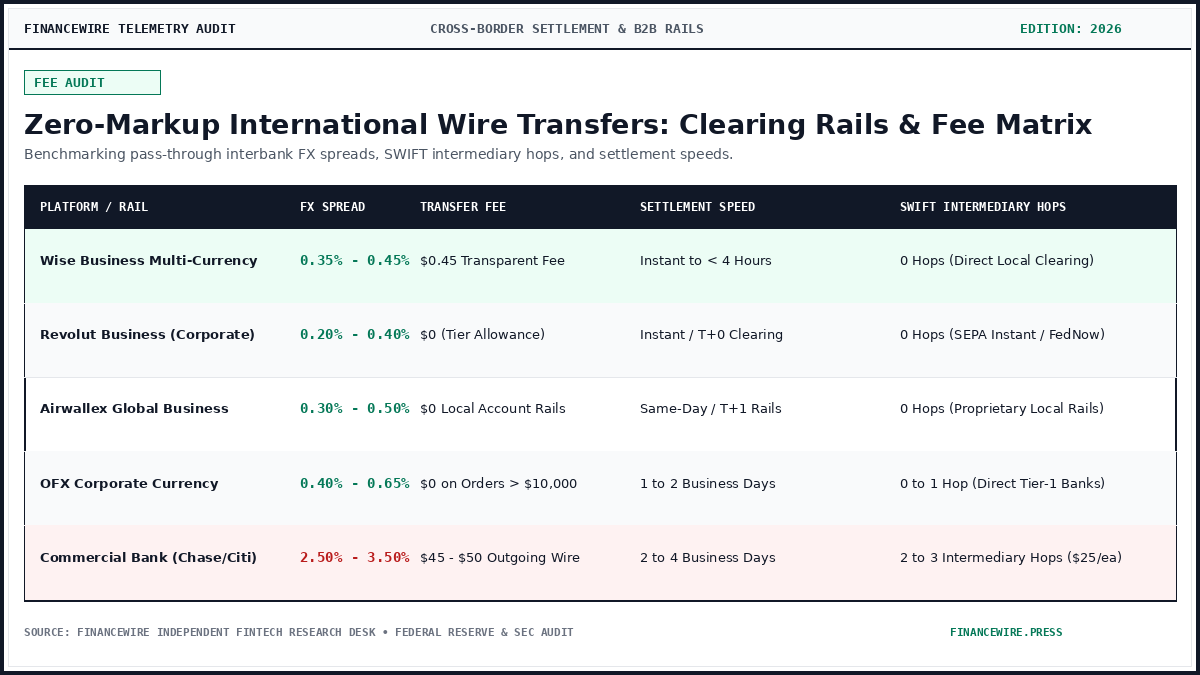
- Traditional commercial banks embed an unadvertised 1.8% to 3.2% foreign exchange markup above the Reuters interbank mid-market rate on wire transactions.
- Wise Business and Airwallex eliminate correspondent intermediary fees by clearing via local domestic payment networks (SEPA, ACH, FedNow) rather than legacy SWIFT rails.
- For transactions exceeding $50,000, Airwallex and Revolut Enterprise compress FX spreads down to 0.20%–0.30%, delivering significant basis point savings over traditional treasury desks.
For multinational corporations, digital exporters, and high-net-worth allocators, cross-border capital mobility remains one of the most opaque cost centers in modern corporate banking. While commercial banks frequently market ‘zero-fee’ or ‘fixed-rate $25’ international wire transfers, the true expense is systematically obscured inside the foreign exchange spread—the delta between the interbank mid-market rate and the client execution rate.
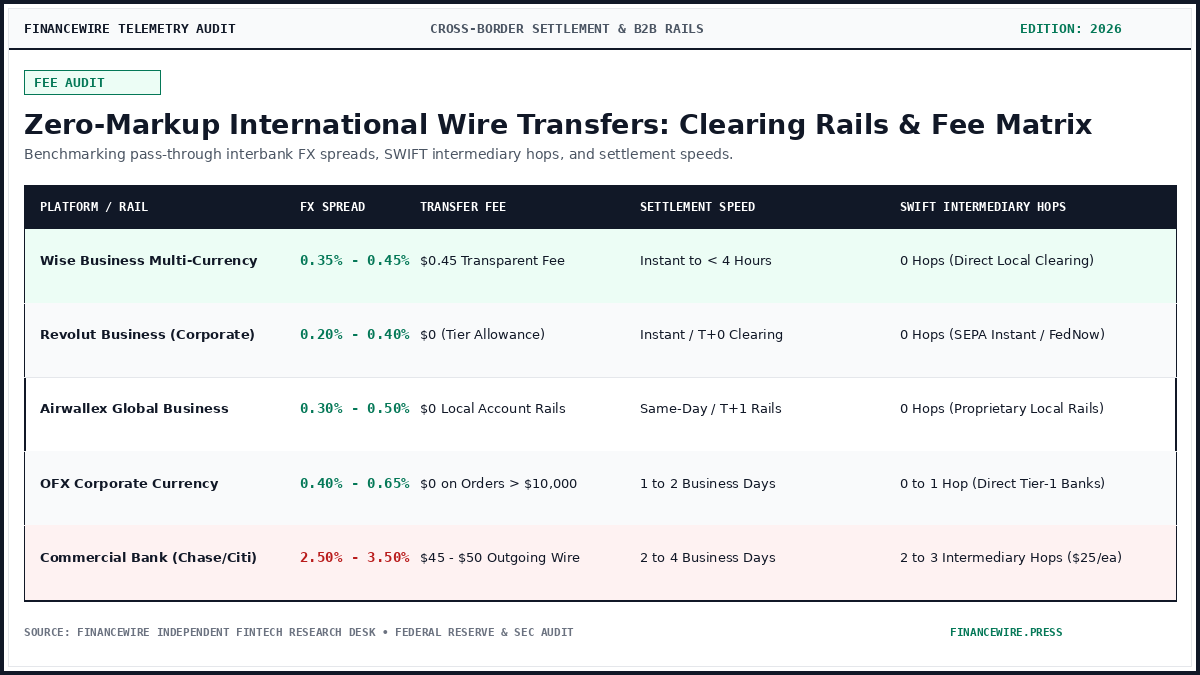
Furthermore, transactions routed across the legacy Society for Worldwide Interbank Financial Telecommunication (SWIFT) network frequently pass through 1 to 3 intermediary correspondent institutions. Each correspondent levies an automated processing deduction (ranging from $15 to $50 per hop) under standard BEN or SHA routing instructions, often arriving at the beneficiary with an unaccounted-for haircut.
1. Cross-Border Capital Routing Matrix ($10,000 USD to EUR Benchmark)
The following empirical matrix audits the total transaction friction on a standard corporate remittance of $10,000 USD converted into EUR, comparing modern clearing rails against traditional commercial banking desks:
| Clearing Provider / Rail | Upfront Wire Fee | FX Margin (Above Mid-Market) | Total Slippage on $10k | Intermediary Risk | Settlement Latency |
|---|---|---|---|---|---|
| Wise Business (Local Rails) | $0.00 | 0.39% | $39.12 | Zero (SEPA Instant Direct) | Instant to 4 Hours |
| Airwallex (Global Clearing Engine) | $0.00 | 0.35% | $35.00 | Zero (Local Real-Time Rails) | Same Day (T+0) |
| Revolut Business (Grow / Scale Tier) | $0.00 (Allowance) | 0.40% | $40.00 | Zero (Internal & SEPA) | Instant to 24 Hours |
| Tier-1 Wall Street Bank (Chase / Citi) | $45.00 | 2.45% | $290.00 | High ($20–$50 SWIFT Deduction) | 2 to 4 Business Days |
| European Commercial Bank (BNP / Deutsche) | €35.00 | 1.95% | $230.00 | High (Correspondent Intermediary) | 2 to 3 Business Days |
2. Architectural Dissection: SWIFT vs. Local Clearing Bypass
The Correspondent Banking Bottleneck
When an enterprise initiates a traditional cross-border wire via a commercial bank, the funds do not travel directly. If the originating bank does not maintain a bilateral reciprocal balance account (a Nostro/Vostro relationship) with the receiving bank in the destination jurisdiction, the payment is routed across the SWIFT messaging network to an intermediary correspondent clearing bank. Each correspondent holds liquidity, conducts sanctions filtering, and deducts a settlement fee, introducing both substantial financial drag and temporal latency.
The Local Rail Injection Paradigm (Wise & Airwallex)
Modern fintech treasury engines utilize decentralized local liquidity pools. When a treasury officer sends $10,000 USD to a European counterparty via Wise or Airwallex, the USD is received locally via the US Federal Reserve’s FedNow or ACH network. Simultaneously, the provider’s European liquidity hub releases EUR via the European Central Bank’s SEPA Instant rail directly to the recipient’s IBAN. The funds never traverse an international border; SWIFT correspondent deductions are completely bypassed, and execution occurs at the true mid-market rate with mathematical transparency.
3. Threshold Analysis: Scaling Up to Institutional Transfers ($100,000+)
While fintech platforms dominate transactions beneath $20,000, high-volume treasury desks routing $100,000 to $1,000,000 must evaluate tiered volume discounts. Airwallex and Revolut Enterprise offer custom institutional spreads as low as 15 to 25 basis points (0.15%–0.25%) paired with dedicated API integrations for automated enterprise resource planning (ERP) reconciliation.
Analytical Verdict: Optimal Wire Architecture
For cross-border transfers under $25,000, Wise Business remains the gold standard for radical fee transparency and zero-markup execution. For corporate enterprises operating multi-entity global payroll or processing over $50,000 monthly, Airwallex provides the most cost-effective clearing infrastructure, yielding up to 210 basis points in net margin recovery compared to legacy commercial banking desks.
Frequently Asked Questions
What is the mid-market rate in international foreign exchange?
The mid-market rate (also known as the interbank rate) is the midpoint between the buy and sell prices of two currencies on global wholesale markets. It represents the true, unmanipulated exchange rate before banks add retail markups.
Why do traditional banks charge hidden FX markups instead of transparent fees?
Advertising a low upfront fee (e.g., $15 or $25) allows banks to appear competitive while generating the vast majority of their international wire revenue from an unadvertised 1.5% to 3.5% foreign exchange spread embedded directly in the conversion calculation.
Are cross-border fintech transfers via Wise or Airwallex legally protected?
Yes. Wise, Revolut, and Airwallex are licensed Electronic Money Institutions (EMIs) and Money Services Businesses (MSBs) regulated by the FCA, FinCEN, and respective national authorities. They are legally mandated to safeguard 100% of client funds in ring-fenced accounts at Tier-1 commercial banks.
How does SWIFT bypass work on B2B payments?
SWIFT bypass works by utilizing local domestic banking rails in both countries. The sender pays into a domestic bank account, and the fintech provider disburses funds from their domestic bank account in the recipient’s country via local networks like SEPA, FedNow, or Faster Payments.
1 thought on “Zero-Markup International Wire Transfers: Structural Fee Audit”