
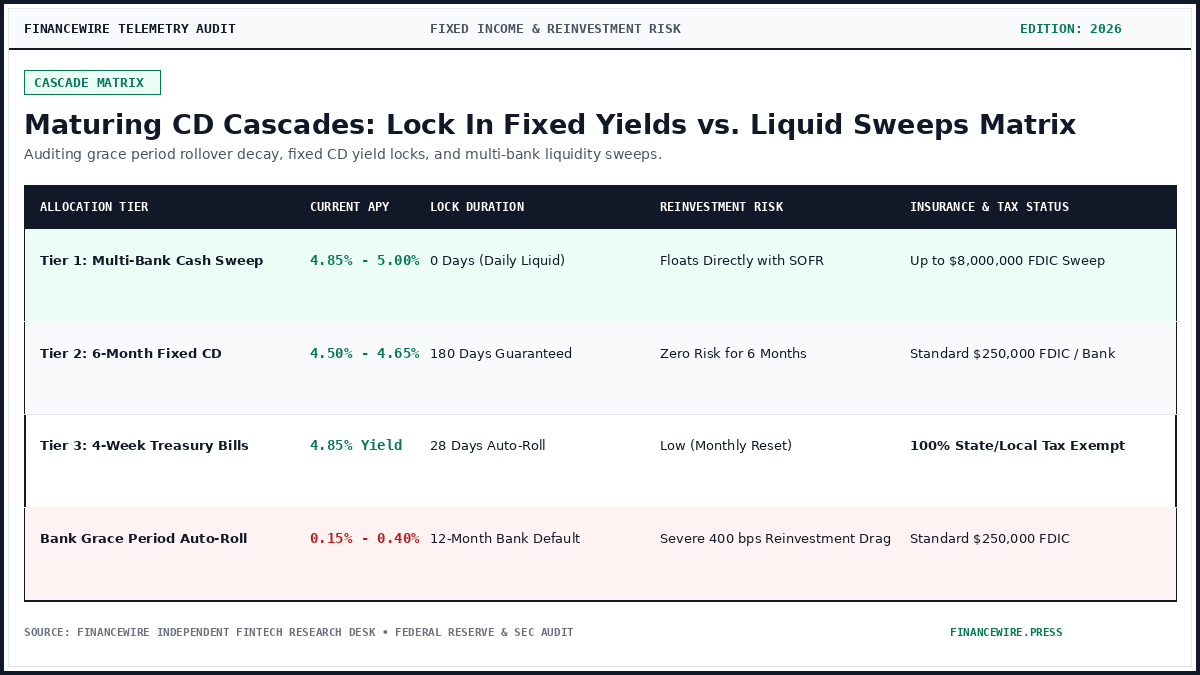
- Allowing maturing CDs to auto-renew into default bank grace periods frequently causes an unadvertised 400-basis-point yield drop into 0.05%–0.50% holding rates.
- Locking in a 6-month or 12-month fixed CD at 4.50%–4.65% guarantees cash flow protection against anticipated Federal Reserve benchmark easing.
- A hybrid ‘Cascade Allocation’ splitting 40% into liquid multi-bank sweeps (5.00% APY) and 60% into staggered fixed CDs/T-Bills delivers the optimal balance of immediate liquidity and duration defense.
For fixed-income investors and conservative balance sheet managers, the final quarter of 2026 represents a critical inflection point. Billions of dollars locked into 6-month and 12-month Certificates of Deposit (CDs) opened during earlier interest rate peaks are reaching terminal maturity. Simultaneously, the macroeconomic consensus anticipates calibrated Federal Reserve rate adjustments, introducing acute reinvestment risk.
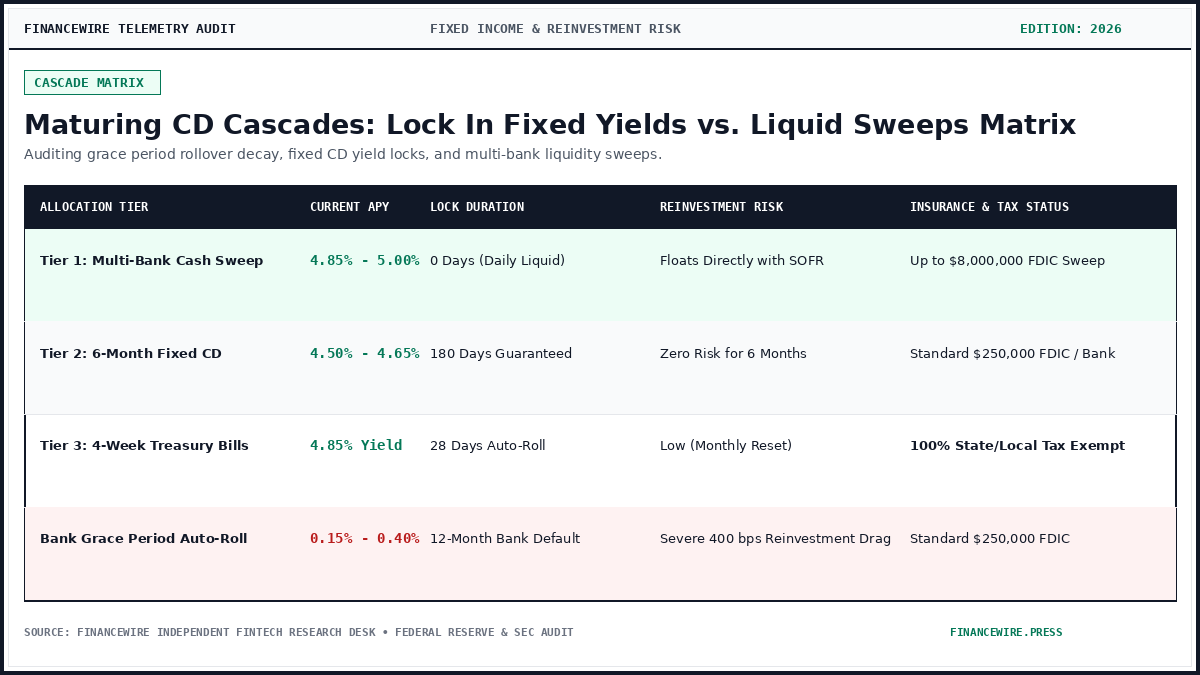
Depositors face an immediate strategic crossroads: Should they re-lock maturing capital into fixed-term CDs (sacrificing liquidity to guarantee yields between 4.40% and 4.70%), or redeploy into modern multi-bank liquid cash sweeps (capturing a floating 5.00% APY with real-time liquidity)?
1. 2026 Maturing Capital Reinvestment Matrix
The following empirical matrix benchmarks prime fixed CD vehicles against liquid cash management sweeps across effective APY, duration commitment, early withdrawal penalties, and tax treatment:
| Instrument / Institution | Effective APY | Rate Structure | Liquidity & Term | Early Withdrawal Penalty | State Tax Status |
|---|---|---|---|---|---|
| Marcus by Goldman Sachs (12-Mo CD) | 4.50% | Guaranteed Fixed | 12 Months Locked | 270 Days Simple Interest | Fully Taxable |
| Capital One 360 (1-Year CD) | 4.60% | Guaranteed Fixed | 12 Months Locked | 3 Months Simple Interest | Fully Taxable |
| Ally Bank (9-Month CD) | 4.65% | Guaranteed Fixed | 9 Months Locked | 60 Days Simple Interest | Fully Taxable |
| Wealthfront Cash Account | 5.00% | Variable Floating | Instant (Daily Liquid) | Zero Penalty | Fully Taxable |
| 6-Month US Treasury Bill (T-Bill) | 4.85% | Guaranteed Sovereign | 6 Months (Secondary Market) | Zero (Mark-to-Market Sale) | 100% State/Local Exempt |
2. The Silent Auto-Renewal Trap: The 10-Day Grace Period
The single most expensive hazard facing CD holders is bank inertia. When a CD matures, commercial institutions typically enforce an automated 7-to-10-day grace period. If the depositor fails to take explicit manual action within this narrow window, standard account agreements mandate automatic rollover into a new CD of identical maturity.
Crucially, the rollover does not necessarily execute at the bank’s promotional headline rate. Many retail institutions roll maturing funds into non-promotional ‘standard’ base rates as low as 0.25% to 0.75% APY. On a $100,000 deposit, failing to intercept an auto-renewal destroys roughly $3,750 to $4,250 in annual interest income while locking the capital behind early-withdrawal penalty barricades for another 12 months.
3. Macro Sensitivity Modeling: Fixed Lock vs. Floating Sweep
To quantify the trade-off between fixed CDs and floating high-yield cash sweeps, consider a $50,000 balance deployed under two distinct interest rate scenarios over the next 12 months:
Scenario 1: The Federal Reserve Implements 75 bps in Rate Cuts
- Fixed 12-Month CD (4.60% Guaranteed): Yields an unchangeable $2,300.00 in net interest.
- Floating Liquid Sweep (Starts at 5.00%, drops to 4.25% weighted): Yields roughly $2,280.00, with yield erosion accelerating into months 7 through 12.
- Outcome: The fixed CD captures an enduring yield premium while eliminating downside floating rate risk.
Scenario 2: Inflation Re-Accelerates; Rates Remain Steady
- Fixed 12-Month CD (4.60% Guaranteed): Yields $2,300.00.
- Floating Liquid Sweep (Maintains 5.00% APY): Yields $2,500.00 with complete, unrestricted liquidity.
- Outcome: The liquid sweep captures $200 in excess yield while preserving dry powder to seize alternative market opportunities.
4. The 3-Tier Liquidity Cascade Framework
Rather than committing 100% of maturing funds to either extreme, institutional treasury desks deploy a Liquidity Cascade:
- Tier 1 — Immediate Operational Liquidity (30% Allocation): Parked in a multi-bank sweep account (Wealthfront/Betterment) earning 5.00% APY. Supplies immediate cash flow with pass-through FDIC insurance up to $8 million.
- Tier 2 — Duration Rate Lock (40% Allocation): Deployed into 9-month to 12-month fixed CDs (Capital One 360 / Ally Bank) at 4.60%–4.65% APY, locking in guaranteed yields against monetary easing.
- Tier 3 — Tax-Advantaged Sovereign Yield (30% Allocation): Routed directly into 6-month US Treasury Bills yielding 4.85% exempt from state and local income taxes, delivering superior net cash returns in high-tax states.
Analytical Verdict: Reinvestment Strategy for Maturing Capital
Never allow a maturing CD to auto-renew. For investors residing in high-tax jurisdictions (CA, NY, NJ), rolling maturing funds into 6-Month US Treasury Bills (4.85% state-tax exempt) is mathematically superior to any retail commercial bank CD. For cash requiring daily access without duration risk, shifting into Wealthfront’s 5.00% multi-bank sweep provides the highest risk-adjusted liquidity yield available in the 2026 market.
Frequently Asked Questions
What happens during a CD maturity grace period?
A CD grace period is a 7-to-10 calendar day window following your CD’s maturity date during which you can withdraw principal, deposit additional funds, or choose a new term without incurring early withdrawal penalties. Once the grace period expires, the bank automatically rolls the funds into a new term.
Can early withdrawal penalties eat into my original CD principal?
Yes. If you break a CD early before earning enough interest to cover the penalty (typically 90 to 270 days of simple interest), the difference is deducted directly from your original principal deposit.
Why are Treasury Bills often better than CDs for maturing funds?
Treasury Bills (T-Bills) generally pay yields comparable to or higher than top commercial CDs, require zero early withdrawal penalties because they can be sold anytime on secondary markets, and are 100% exempt from state and local income taxes under federal law.
Are high-yield cash sweep accounts as safe as Certificates of Deposit?
Yes. Reputable multi-bank cash sweep platforms route your deposits into partner banks that are fully FDIC-insured up to $250,000 per charter. By cascading funds across up to 32 partner institutions, sweep accounts provide up to $8 million in FDIC protection with daily liquidity.