
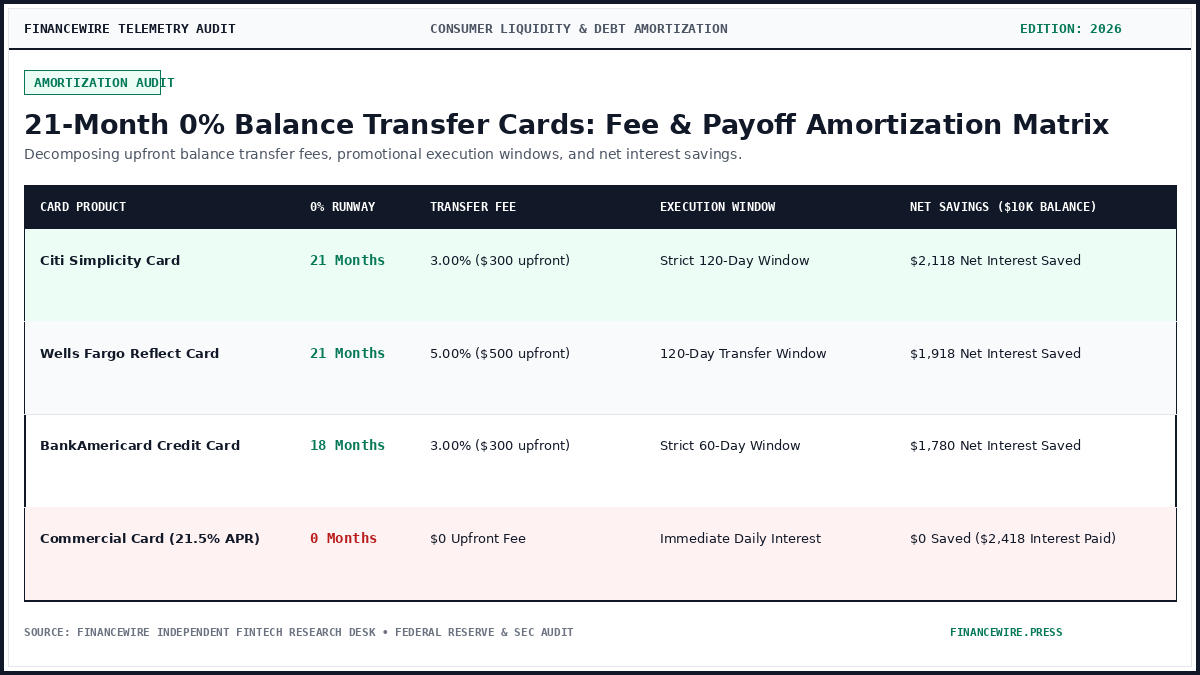
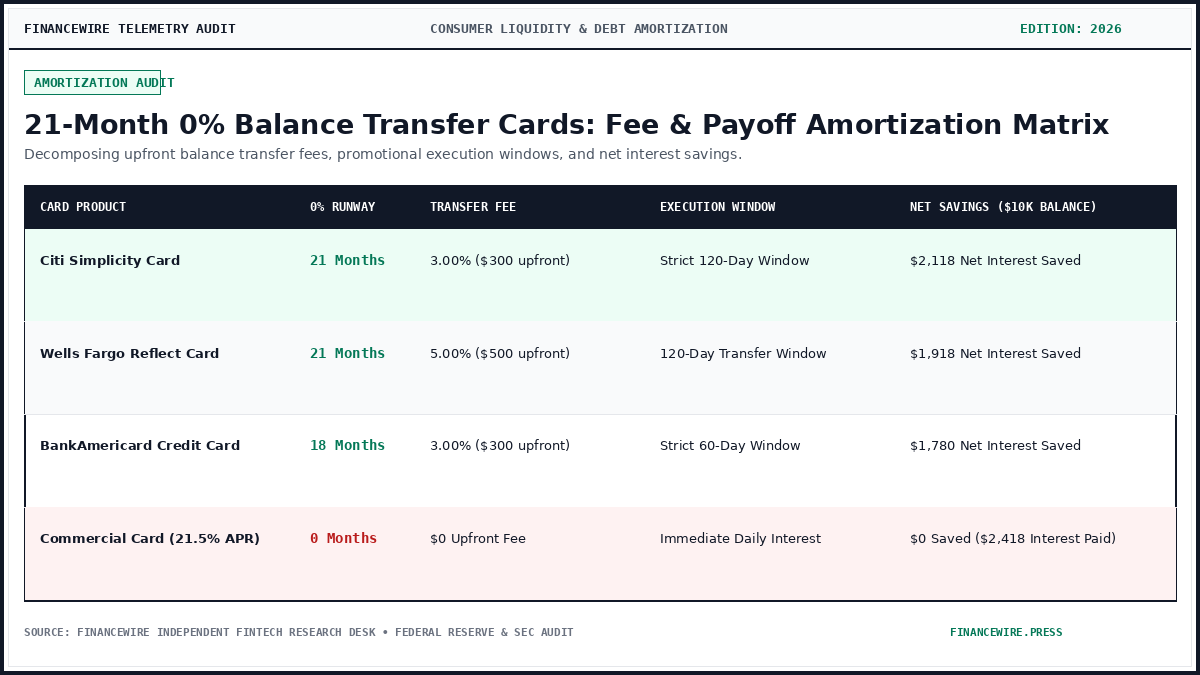
- Transferring a $10,000 balance from an average 21.5% APR credit card to a 21-month 0% APR vehicle saves between $2,150 and $2,400 in net interest expense, even after paying the upfront transfer fee.
- Citi Simplicity offers the most forgiving structural terms with zero late fees and zero penalty APR, while BankAmericard delivers a compressed 3% transfer fee window on initial transfers.
- A successful balance transfer requires strict amortization discipline: dividing total transferred principal plus the fee by 20 months ensures complete payoff before the retroactive variable rate triggers.
With average revolving credit card interest rates hovering at a restrictive 21.5% to 24.8% across US financial institutions, carrying unsecured consumer debt has become an unsustainable drag on personal balance sheets. Ahead of peak holiday expenditure cycles, commercial banks deploy aggressive customer-acquisition promotions: 0% introductory APR balance transfer cards extending up to 21 billing cycles.
However, navigating these promotional offers requires looking past the ‘zero percent’ headline. Borrowers must perform an empirical mathematical trade-off: balancing the upfront balance transfer fee (typically 3% to 5% of the transferred sum) against the net present value of avoided monthly compounding interest.
1. 2026 Prime 21-Month Balance Transfer Matrix
The following empirical matrix benchmarks the top 0% APR liquidity products across introductory term length, transfer friction, post-promotional rates, and protective clauses:
| Credit Card / Issuer | 0% Intro Duration (Transfers) | Upfront Transfer Fee | 0% Intro Duration (Purchases) | Post-Promo Variable APR | Annual Fee |
|---|---|---|---|---|---|
| Citi® Simplicity® Card | 21 Months | 3% ($5 min) in first 120 days, then 5% | 12 Months | 18.49% – 29.24% | $0 |
| Wells Fargo Reflect® Card | Up to 21 Months (18 mo + 3 mo extension) | 5% ($5 min) | Up to 21 Months | 17.49% – 29.24% | $0 |
| BankAmericard® credit card | 18–21 Billing Cycles | 3% ($10 min) in first 60 days, then 4% | 18–21 Billing Cycles | 15.49% – 25.49% | $0 |
| U.S. Bank Visa® Platinum Card | 21 Billing Cycles | 3% ($5 min) | 21 Billing Cycles | 18.74% – 29.74% | $0 |
2. The Mathematical Breakeven Calculus ($10,000 Debt Model)
To evaluate whether paying an upfront balance transfer fee yields empirical net savings, consider a standard consumer holding a $10,000 balance on an existing credit card with a 21.5% variable APR:
Scenario A: Maintaining the Balance on the Existing Card (21.5% APR)
If the borrower pays $500 monthly toward the $10,000 balance on the original card, the amortized timeline reveals massive interest drag:
- Total Time to Payoff: 25 Months
- Total Cumulative Interest Paid: $2,418.60
- Total Out-of-Pocket Expense: $12,418.60
Scenario B: Transferring to a 21-Month 0% APR Card (3% Transfer Fee)
By executing an automated balance transfer to Citi Simplicity or BankAmericard within the promotional window:
- Upfront 3% Transfer Fee: $300 added to principal ($10,300 total new balance)
- Required Monthly Payment (Over 21 Months): $10,300 ÷ 21 = $490.48/month
- Total Cumulative Interest Paid: $0.00
- Net Dollar Savings: $2,418.60 – $300 = $2,118.60 in pure cash preserved
Even if the issuer charges a higher 5% transfer fee ($500), the net interest savings still exceed $1,918.60, delivering an unmistakable risk-free return on capital.
3. Structural Traps to Avoid
The 60-Day to 120-Day Execution Window
Balance transfer promotional rates do not remain open indefinitely after account opening. Card issuers enforce strict initial transfer deadlines—typically 60 to 120 days from approval. Submitting balance transfer requests after this promotional window will incur the standard non-introductory APR (often 20%+) immediately.
Inter-Bank Routing Restrictions
Federal lending regulations and issuer policies prohibit balance transfers between accounts issued by the same banking entity. For example, a debt held on a Chase Sapphire card cannot be transferred to a Chase Slate or Chase Freedom card. Transfers must execute cross-institutionally (e.g., Chase to Citi, Capital One to Wells Fargo, or Discover to Bank of America).
Mixing Promotional Debt with New Purchases
Unless the card offers matching 0% introductory APR on purchases (such as the Wells Fargo Reflect or U.S. Bank Visa Platinum), new retail charges should never be placed on a balance transfer vehicle. While the Credit CARD Act of 2009 mandates that payments above the minimum must be allocated to the balance with the highest APR, mixing balances complicates statement tracking and risks accidental finance charges.
Analytical Verdict: Selecting Your Zero-Interest Vehicle
For pure balance transfer optimization with absolute forgiveness clauses, the Citi® Simplicity® Card is mathematically superior: it charges zero late fees, enforces zero penalty APRs, and offers a generous 120-day promotional window at a 3% fee. For borrowers who also anticipate major upfront holiday purchases requiring 21 months of runway, the Wells Fargo Reflect® Card provides matching purchase and transfer duration under a single credit line.
Frequently Asked Questions
What is a balance transfer fee, and how is it calculated?
A balance transfer fee is a one-time administrative charge levied by the receiving card issuer, typically 3% to 5% of the total balance being moved (subject to a minimum charge of $5 to $10). For example, transferring $5,000 at a 3% fee adds $150 to your initial balance.
Can I transfer debt between two credit cards from the same bank?
No. Card issuers prohibit balance transfers between accounts under their own brand. To utilize a 0% introductory balance transfer offer, you must move the debt to an entirely different banking institution (e.g., from American Express to Citi).
What happens if I don’t pay off the full balance before the 21 months end?
Any remaining unpaid balance after the 21-month promotional period expires will begin accruing interest at the card’s standard ongoing variable APR (typically 17% to 29%). Unlike predatory deferred interest store cards, prime bank cards do not retroactively charge interest on the entire original amount.
Does doing a balance transfer hurt my credit score?
Opening a new card causes a temporary 5-point dip from the hard credit inquiry. However, by increasing your total available credit limit and substantially reducing your credit utilization ratio as you pay down the debt interest-free, a balance transfer typically produces a net positive credit score improvement within 3 to 6 months.